Traditional culture shines as festive travel surges during Spring Festival holiday

BEIJING, Feb. 21 (Xinhua) -- More than halfway through China's nine-day Spring Festival holiday, which began on Feb. 15, travel enthusiasm shows no signs of slowing.
Across the country, visitors are flocking to destinations where glowing lanterns, lively temple fairs, and colorful folk parades fill the air with festive cheer, seeking immersive experiences of traditional culture.
Transport authorities estimate that average daily cross-regional trips during the holiday may reach a record 299 million. Meanwhile, travel platform data also show searches for folk activities more than doubled year on year.
TRADITION MEETS INNOVATION
During the holiday, Lin Yu, a history lover from Guangdong Province with a keen interest in the Song Dynasty (960-1279), traveled to Qinghefang Historic and Culture Feature Street in Hangzhou, east China's Zhejiang Province.
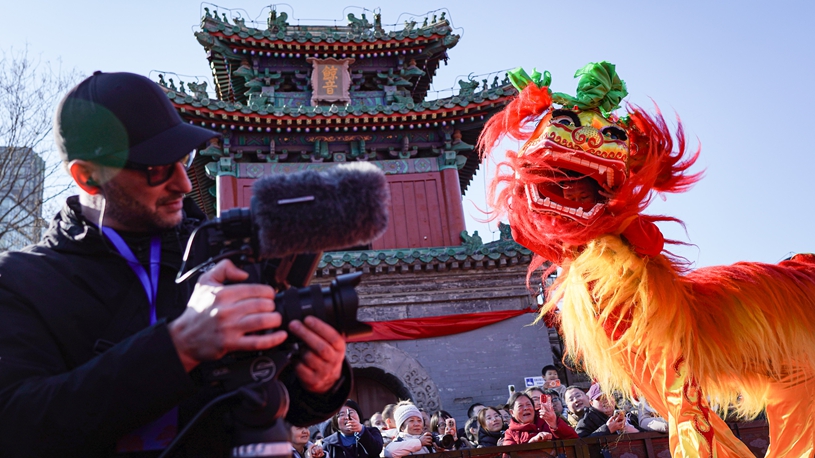
The 800-year-old district, once a bustling commercial hub, is hosting a lineup of cultural activities, with tech-driven performances stealing the spotlight. Robot dogs move in rhythm with traditional lion dances, while drones paint phoenix patterns across the night sky, creating a dazzling festive display.
"You can see history come alive here while soaking in the festive buzz," Lin said, adding that he had made the special trip after hearing about the festive events being held there.
Beyond the high-tech spectacles, this year's Spring Festival is also offering various immersive and interactive settings where visitors can engage directly with traditions and experience the depth of Chinese culture.
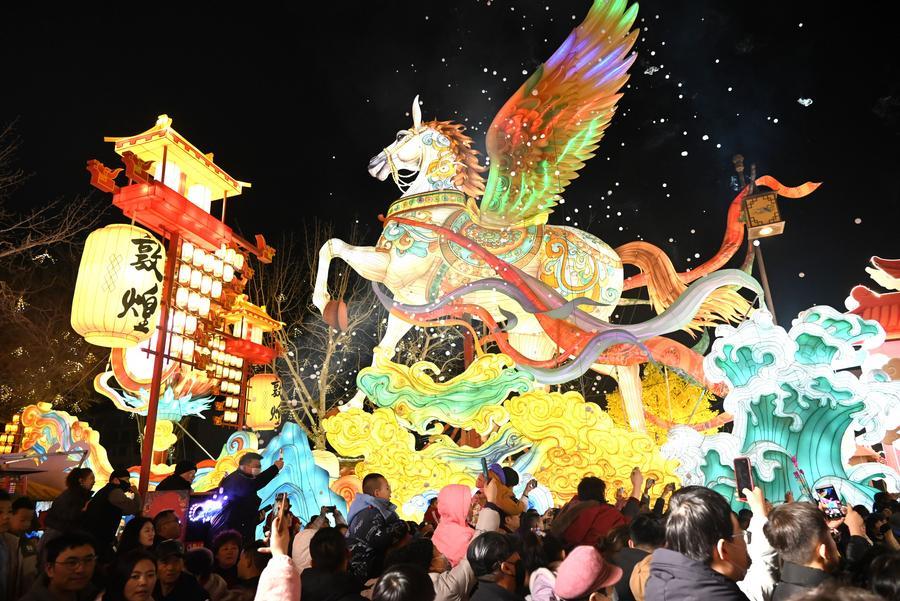
At the Xi'an City Wall scenic area, a themed lantern fair illuminates the centuries-old ramparts, featuring 39 zodiac horse installations, including winged designs inspired by historical relics. Inside the site, a national-level intangible cultural heritage string-puppet exhibition is on display.
"The show breaks the traditional boundary between stage and audience," said Zhu Yuan, an official with the city wall's management authority. "Ancient craftsmanship is brought back to life on the historic walls."
Ahead of the Spring Festival, China launched a month-long cultural and tourism campaign to spur consumption. Around 30,000 events -- ranging from traditional New Year customs and performances to winter sports and family travel activities -- have been held, accompanied by more than 360 million yuan (about 51.6 million U.S. dollars) in consumption vouchers and subsidies.
In Xiyang County, Shanxi Province, multiple Spring Festival-exclusive immersive shows and interactive games enable visitors to explore the folk-themed streets like a treasure hunt, while collecting blessings and joy along the way. In Quanzhou City, Fujian Province, tourists wearing traditional floral headpieces wander through centuries-old streets, pausing to take photos beneath the curved eaves of red-brick houses.
Official data show that on the first day of the holiday, foot traffic and sales at 78 key shopping streets and districts rose 23.2 percent and 33.2 percent year on year, respectively. Travel platform Fliggy reports that searches for folk activities jumped 117 percent from a year earlier, while searches for trips featuring folk customs and intangible heritage experiences rose more than 60 percent.
"This year's Spring Festival shows how traditional Chinese culture is shaping new consumption trends," said Dai Bin, head of the China Tourism Academy, noting that the "China-chic" aesthetic has become especially popular among young travelers.
A GLOBAL CONNECTION
"Good luck in the Year of the Horse!" On Feb. 15, the first day of the extended holiday, officers at Beijing Capital International Airport greeted international travelers with traditional "Fu" characters and New Year wishes.
During the Spring Festival, more international visitors are crossing mountains and seas to experience China's most important family holiday and its traditions. Travel and Tour World, an international travel media outlet, called the 2026 Spring Festival travel "evolving into a global tourism phenomenon" in a recent article.
On social media, amidst rising trends such as "becoming Chinese" and "very Chinese time," users are also enthusiastically sharing their experiences and impressions of the celebrations.
The National Immigration Administration predicts that daily cross-border passenger flow during the holiday will exceed 2.05 million, up 14.1 percent from last year. Data from online travel platform Qunar show that domestic flight bookings made by non-Chinese passport holders rose 20 percent year on year during the festival period, with trips spanning over 100 Chinese cities.
In Shanghai, international visitors can join specially designed Spring Festival citywalks in the downtown area. Along the way, they can try their hand at calligraphy by writing spring couplets, dress in traditional Chinese attire, and learn to make local-style wontons.
"My grandpa is from Shanghai, and I'm very excited to get back to my roots a little bit," said Grace Schenkel from the United States. "I am excited to make my own dumplings, and I can't wait to show the videos to him."
Inbound tour groups from the Republic of Korea and Thailand to Shandong Province immersed themselves in local customs during the holiday. On Chinese New Year's Eve, more than 70 Thai visitors marked the occasion with an authentic celebration -- enjoying hotpot, festive songs, the Spring Festival Gala and dumplings.
"The Spring Festival group tours featured six-day itineraries blending natural scenery with cultural and folk experiences," said Chen Fang, deputy general manager of a local travel agency, adding that writing "Fu" characters and watching performances were among the most popular activities.
In late 2024, UNESCO inscribed "Spring Festival, social practices of the Chinese people in celebration of the traditional New Year" on the Representative List of the Intangible Cultural Heritage of Humanity.
"Tourists are increasingly visiting China not just for its natural beauty and historical sites but also for the chance to celebrate one of the world's oldest and most influential festivals," said another article from the Travel and Tour World.
China's visa-free policies and facilitation measures have fueled the inbound boom. Starting from Feb. 17, the first day of the Chinese New Year, China extended its visa-free policy to ordinary passport holders from Canada and Britain, bringing the total number of countries enjoying unilateral visa-free access to 50.
China has also rolled out special initiatives to boost holiday spending, including easier entry for international visitors, improved payment options, and duty-free shopping incentives.
"Thanks to the visa-free policy, I got to experience 'Becoming Chinese' and celebrate the most authentic Chinese New Year. I feel very satisfied," said a British visitor at the end of the trip to China. ■








Comments